FEVERDREAM™
Ten machines for drums · Fireball Audio
Every other saturator is one machine with a drive knob. This one is ten machines, and each brings its own controls.
Fever Dream is a saturation plugin for drums. MODEL picks the machine: two tape decks, two preamps, three compressors, a console channel with its limiter, a passive program EQ and a valve distortion unit. The panel then changes to that machine's own controls — tape formula and speed on a deck, stepped gain and an inductor EQ on a preamp, release and ratio on a limiter. Ninety-two controls across the ten machines, none shared, because a tape machine and a limiter have nothing in common.
Each machine is voiced against published measurements of the circuit it is modelled on, and where that research found something the folklore misses, that is what the machine does. The preamp's transformers distort more the lower the note, so a kick saturates while the snare stays clean. The FET limiter's grit on drums comes from its release, not its attack. The passive EQ's low boost sits before its output transformer, so a boosted kick saturates at its fundamental.
And drive is colour, not loudness. Every drive control is level-compensated, fitted per machine against the machine itself, so turning RECORD or DRIVE up changes what you hear rather than how loud it is. The controls whose job is to reduce — thresholds, ratios — are left alone: a limiter is supposed to limit. For the rest there is MATCH.
The panel
One panel, ten machines behind it
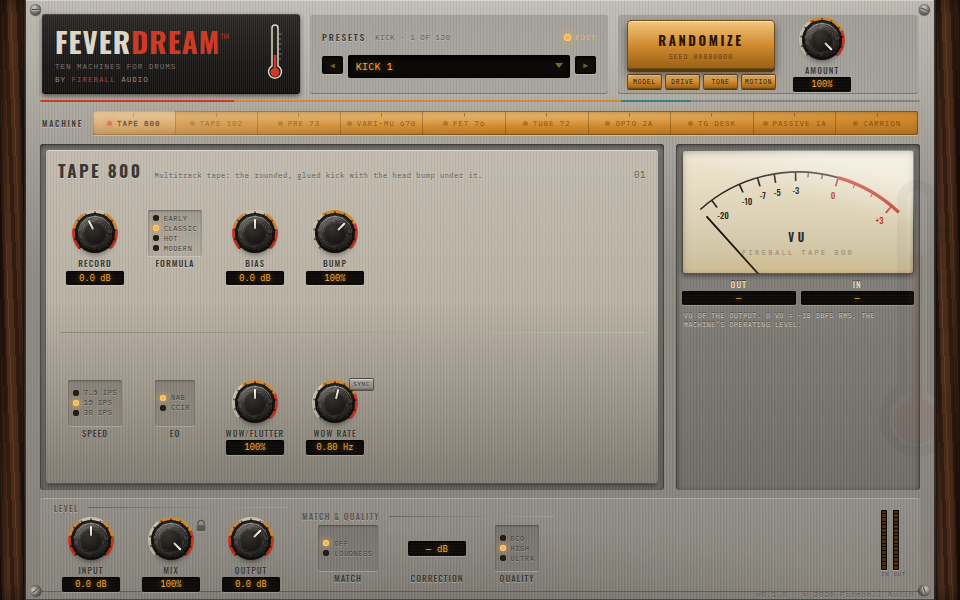
The machine keys at the top, the active machine's plate in the middle, and the controls every machine shares along the bottom. Values read off lit amber windows, the same as below.
The global chain
Six controls that sit around every machine
Whichever machine is selected, the drums take the same route through it. The dry signal is delayed by exactly the machine's latency, so MIX blends like with like and parallel drums never comb.
- INyour drums
- INPUThow hard the machine is hit
- MACHINEone of ten, oversampled
- COMPENSATIONdrive changes colour, not level
- MIXblended with the time-aligned dry
- MATCHoptional: back to input loudness
- OUTPUTfinal level
Which machine the drums go through. Each one brings its own controls.
Level into the machine. 0 dB puts −18 dBFS RMS at the machine's operating level.
Final level, after MIX and after MATCH.
Dry/wet. The padlock keeps it put through preset loads and RANDOMIZE.
Holds the output at the same loudness as the input, so you hear the colour and not the level.
Oversampling. HIGH is what each machine was voiced at; ECO for big sessions; ULTRA for final bounces.
Drive is colour
INPUT and every machine's drive controls change how hard the machine is hit. The wet path is brought back down afterwards, so the level stays put and the character moves.
Switch mid-playback
Changing machine or QUALITY while the track plays crossfades to the new one over 30 ms, pre-rolled so it arrives already warmed up. No click, no gap.
Latency that never moves
The same latency at every machine and every QUALITY setting, so switching never shifts your host's delay compensation and dry and wet always line up.
A randomiser with manners
MIX, OUTPUT, INPUT, MATCH, QUALITY are never rolled. MIX lock holds MIX through presets as well. Every roll is level-checked and re-drawn if it lands far from the input's loudness.
120 factory presets in 12 categories
The ten machines
Each machine's controls are grouped the way RANDOMIZE rolls them — drive, tone and motion. The value in the lit window is the default.
TAPE 800
Multitrack tape: the rounded, glued kick with the head bump under it.
Drive
How hard the drums hit the tape. Colour, not loudness: the output is compensated.
Which tape. EARLY breaks up soonest and grittiest; MODERN takes the most level and clips hardest.
Under-bias: brighter and grainier. Over-bias: darker, smoother, more glue.
Tone
Tape speed. Slower = bigger low bump, earlier top-end squash, more wobble.
Recording curve. NAB saturates the kick first; CCIR saturates the snare and cymbals first.
The low-end bump tape puts under a kick. 0 = flat, 150 = exaggerated.
Motion
How much the transport wobbles. 100 % is a healthy machine; 400 % is a tired one.
Speed of the slow pitch sag. With SYNC on it snaps to a note length, so the sag lands on the beat.
Locks WOW RATE to the host tempo.
TAPE 102
The mastering deck: harder, later knee than TAPE 800, flatter bump, less wobble.
Drive
How hard the drums hit the tape. Colour, not loudness.
Which tape. VINTAGE is soft and early; MODERN is clean with a hard knee.
Under: brighter and grittier. Over: darker, rounder, more compressed.
The deck's transformers. IN adds low-end weight and saturation; OUT is the transformerless mod.
Tone
3.75 is lo-fi and squashed on top; 30 is the open, modern master.
Tape width. Wider = flatter, deeper low end and less hiss.
Motion
Transport wobble. 100 % is spec.
Speed of the slow pitch sag; snaps to note lengths with SYNC.
Locks WOW RATE to the host tempo.
PRE 73
Class-A preamp and inductor EQ. The iron distorts more the lower the note: kicks saturate, snares stay clean.
Drive
The stepped preamp gain. Compensated, so each click is more colour, not more level.
Into the output stage. Above 0 it clips harder and brighter; below 0 is 'gain hot, level down'.
How much the transformers saturate. The lows go first.
Tone
Low shelf frequency (Hz): kick weight at 35/60, tom body 110, snare body 220.
Low shelf boost/cut. Boost here and the iron saturates the fundamental.
Presence band: snare crack 3.2k/4.8k, kick beater 1.6k/3.2k, box cut 360/700.
Presence boost/cut.
12 kHz shelf for overheads and room air.
18 dB/oct high-pass. With LOW boosted it gives the resonant, tightened kick.
Motion
How long the preamp 'breathes' back after a hit drives it into clipping.
Locks BLOOM to a note length, so it recovers just before the next hit.
VARI-MU 670
Variable-mu tube limiter: gain reduction that thickens, with a fast-then-slow release network.
Drive
Drive into the tubes: more limiting and more third harmonic with it.
How much it limits at every level.
Soft and gentle at 0, near brick-wall at 100.
Push-pull imbalance: adds second harmonic and a 'thump' on each hit.
Tone
MID/SIDE limits the centre harder than the sides, which widens overheads and rooms.
Stops the kick driving the whole bus. Fully down = off.
Motion
1–2 punch and pump, 3 general, 4 slow glue, 5–6 auto-levelling. SYNC times the release to the tempo.
Note length the release recovers over when TIME CONSTANT is on SYNC.
FET 76
FET limiter. On drums the distortion comes from the release, not the attack.
Drive
Drive into the FET and preamp. Fixed threshold, so this is also how much it compresses.
The line amp after the FET. Near the top it clips, like the hardware's output stage.
OFF keeps the amps in the path with no compression: colour only.
Morphs toward the all-buttons-in destruction. About 60 % is the two-button trick.
Tone
BLUE is the earliest and most programme-dependent; BLACK the classic; SILVER the cleanest.
Keeps the kick from pumping the whole kit.
Motion
1 slow (800 µs) to 7 fast (20 µs).
How fast it lets go. Fast release is where the drum grit lives.
Locks RELEASE to a note length (86 % recovered by the next division).
TUBE 72
Broadcast tube preamp: fixed gain, so the only question is how hot you hit it.
Drive
How hot the drums hit the tubes. Compensated.
Input transformer sag on the kick before the tubes clip.
0 is symmetric and edgy; positive is thick and even.
Tone
STANDARD, HOT (6 dB more gain, heavier load) or CASCADE (darker top, bigger bass).
Low roll-off options, from none to the cascade's shelving.
Broadcast top limit, or a heavy 3 kHz for a telephone kit.
Motion
How much the tubes choke after a loud hit.
How long the choke takes to clear.
Locks BLOCK TIME to a note length for rhythmic gated crunch.
OPTO 2A
Optical leveller: slow, programme-dependent, and the tube output stage is where the colour lives.
Drive
How much it levels. 30–50 is the useful zone.
Drive into the output tube and transformer. The top third is where it saturates. Compensated.
COMPRESS ≈ 3:1 and programme-dependent; LIMIT is near brick-wall.
Tone
Makes it react more to snare and cymbals and leave the kick alone.
The light cell's age. LATE is fastest and best on drums; WORN floats the most.
Motion
The cell remembers how hard it worked. 0 = tight single release; 200 = a floating leveller.
Times the fast release stage to the tempo. The slow tail still floats.
TG DESK
Transistor console channel and its limiter: germanium or silicon, and a squash that breathes.
Drive
GERMANIUM is round and even; SILICON is open with an odd-harmonic fizz.
Into the amp and limiter. Compensated.
COMP 2:1, LIMIT 7:1. The FAST versions clamp the transient; the normal ones let the snare crack through.
How deep the squash goes.
Tone
Bass shelf frequency (Hz).
Bass boost/cut in 1 dB steps.
Broad presence band: snare crack 2.8k/4.2k, overhead sheen 10k.
Presence boost/cut in 1 dB steps.
OFF lets the kick drive the pump (the classic sound); 90 Hz stops it.
Motion
How fast the squash breathes back. SYNC makes it breathe in time.
Note length the squash recovers over when RECOVERY is on SYNC.
PASSIVE 1A
Passive program EQ and tube make-up. The low boost sits before the output iron, so a boosted kick saturates at its fundamental.
Drive
Pushes the make-up tubes and output iron. Compensated.
Tone
Low frequency (Hz) for both BOOST and ATTEN.
Low shelf boost.
Low cut. With BOOST it makes the famous shelf-plus-dip.
High boost frequency: snare crack at 4–5k, air at 10–16k.
Resonant high boost.
Sharp to broad. Broader also lowers the peak, as on the hardware.
High cut frequency.
Gentle top roll-off to tame cymbals after drive.
CARRION
Dedicated valve destruction: fat, edgy, or starved until it gates and octaves.
Drive
TRIODE is fat and even (kick, bus); PENTODE is edgy and odd (snare, rooms); OCTAVE gates and doubles (effects).
How hard the valve is driven. Goes to 11. Compensated.
+20 dB and the input valve distorts too.
The valve's operating point, on the mA meter. High is round and loud, 0.25–0.3 cleanest, below 0.15 it starts to gate.
The output valve. Past 9 it clips a second time, a glue on the bus. Compensated.
Tone
Low-pass after the distortion to turn fizz into something musical.
Motion
How long the valve takes to recover after a hit starves it. Short = gritty chatter; long = pumping.
Sweeps BIAS in time with the track: stuttering, sputtering drums.
Note length of one BIAS MOD cycle. Always in time.
Shape of the bias sweep.