CRYPSIS™
Eight-pedal character chain · Fireball Audio
Every other multi-effect decides the order for you. This one lets you move the pedals.
Distortion into a delay gives you clean repeats of a dirty sound. A delay into distortion wrecks the repeats themselves, and each one comes back dirtier than the last. They are the same two effects and they are not the same instrument. Crypsis has eight, and you drag them into whatever order you want — 40,320 of them, before you touch a knob.
The panel
Everything on one page, in eight bays
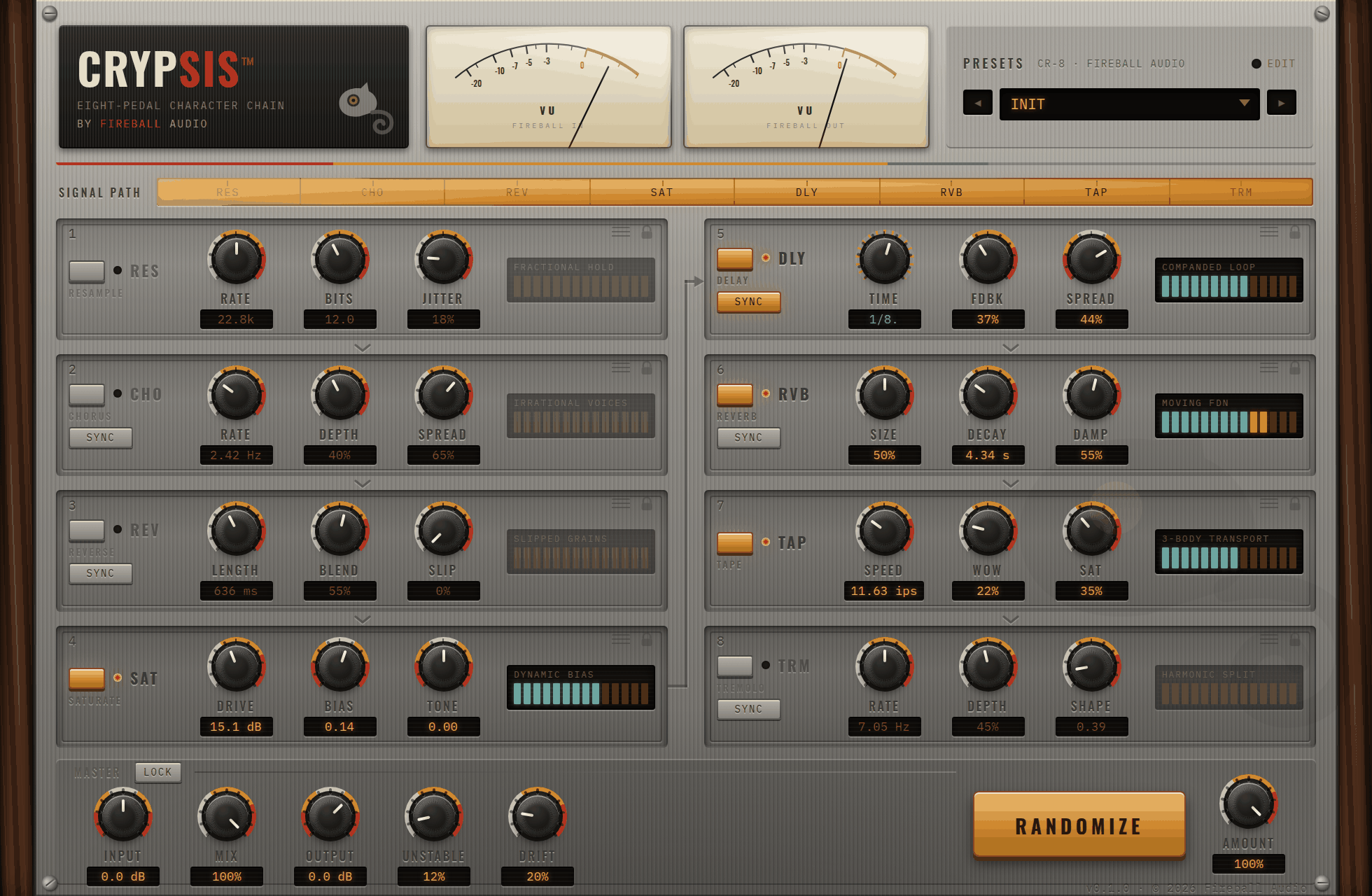
Every control
What each one does, and what it does to the sound
Each control gets the same two pictures: the sound with it turned down, and with it turned up, drawn to the same scale so the difference between them is the real difference.
Every picture on this page was produced by running the actual plugin code at the two settings named underneath it and recording what came out. None of them is an illustration.
Drives the signal into a curve so it stops being clean. What makes this one worth having is that it does not sound the same all the way through a note: it opens up on the hit and settles on the tail, which is what valves and transformers do.
How hard you push. Low is a little thickness and glue. High is obvious, deliberate distortion. The line bending away from the dashes is the sound being squashed.
How: The curve is tanh(x + b) − tanh(b); output is gain-compensated against DRIVE so turning it up does not simply mean turning it louder.
Which half of the wave gets squashed harder. Centred is smooth and even. Pushed either way is raspier and more vocal — the difference between a warm hum and a growl.
How: Bias sets the operating point, so it chooses the even/odd harmonic balance. It also tracks an envelope (2 ms attack, 90 ms release), which is why the character shifts across a note.
Bright or dark, but applied before the distortion as well as after — so it changes which parts of the sound get dirty, not just the EQ afterwards.
How: A matched high shelf at 2.6 kHz, Q 0.62, up to ±7 dB before the shaper and half its inverse after. Full inversion would cancel the tonal effect; half keeps the changed emphasis.
Throws away detail on purpose: fewer samples per second, fewer steps in the level, and an unsteady clock. This is the sound of early samplers and cheap digital gear.
How often the sound is looked at. Turn it down and the smooth wave becomes a staircase — you can see the steps getting wider in the picture, and you hear it as grit and a metallic edge.
How: The hold period is FRACTIONAL, so the rate is continuous rather than sr/1, sr/2, sr/3… That keeps the alias products off a fixed harmonic lattice, which is the ring most crushers have.
How finely the level is measured. Fewer bits means the wave has to snap to coarse heights, which adds a gritty fuzz. Below about 8 it stops being subtle.
How: Error feedback rather than plain truncation: the previous sample’s quantisation error is subtracted from the next, pushing the error spectrum up and off the note.
Makes the clock unsteady, so the steps are not all the same width. Turn it up and the crunch stops being a clean buzzing tone and becomes texture.
How: The hold period is modulated per sample, which smears the alias products across frequency instead of leaving them as discrete tones.
Tape did three things to sound: it wobbled, it lost the very top, and it lifted the bottom. All three follow the speed of the machine, so SPEED here changes the tone as much as it changes the wobble.
How fast the imaginary tape is running. Slow is darker with a fatter bottom end; fast opens the top back up. The picture is the actual tone curve at each speed.
How: Head bump is a peaking filter at ~55 Hz at 7.5 ips, moving lower and louder as speed drops. HF loss corner ~9 kHz at 7.5 ips, opening as speed rises.
How unsteady it runs. The picture is the pitch of a steady tone put through it: flat when it is off, drifting up and down when it is on. It never settles into a pattern you can predict.
How: Three oscillators at deliberately incommensurate rates — 0.61, 6.3 and 11.9 Hz — plus a random wander, so the composite does not repeat inside a phrase. Measured here at ±1.5% around 1 kHz.
How hard the tape is being hit. Turn it up and the peaks flatten off, which is the compression that makes tape glue a mix together.
How: tanh with a memory term: the output leans on where it was a sample ago, a cheap stand-in for hysteresis, which is what gives the stage its lag on fast transients.
Copies the sound, detunes each copy slightly, and moves them around. The result is wider and thicker. The thing most chorus gets wrong is that its voices line up again on a cycle you can hear as a pulse; these never do.
How fast it moves. Very slow is a gentle drift you notice only when it stops. Fast is an obvious warble. The picture is the level wobbling as the voices move past each other.
How: Three voices at rate ratios 1 : φ : φ². Irrational, so they never return to the same relative phase and no repeat cycle exists to be heard.
How far each copy drifts from the original. A little is thickening. A lot is seasick, in a good way.
How: Cubic interpolation on the delay line. Linear interpolation is a lowpass whose corner moves with the fractional delay, which is exactly why most chorus goes dull at depth.
How far apart the copies sit across your speakers. Down is all in the middle; up throws them wide. The two pictures are the left and the right channel.
How: Voice pan positions are hard left, centre and hard right, pulled toward the middle as SPREAD drops.
Turns the volume up and down in a rhythm. The old amplifier trick this copies did something cleverer than that: it rocked the low and the high halves of the sound against each other, so the level stayed put while the tone swung.
How fast it pulses. Slow is a swell that breathes; fast is a flutter. The picture is the level over two seconds at each setting.
How: The two channels are offset a quarter cycle, so the movement travels around the stereo field as well as up and down.
How much it moves. All the way up it does not become an on-off gate the way plain tremolo does — instead the sound goes dark and bright rather than loud and quiet.
How: The band split is at 720 Hz, Q 0.707, and the two bands are modulated in ANTI-PHASE, so the summed level stays roughly constant while the balance rocks.
The shape of the pulse: a smooth swell, a straight ramp, a hard chop, or a falling sawtooth that sounds like something being struck repeatedly.
How: One continuous morph, sine through triangle and soft square to a falling ramp, rather than a switch between separate waveforms.
Grabs short slices of what you play and plays them backwards. The reason most reverse effects are unusable is that the slice starts whenever you switched it on, so the swell always lands slightly wrong. SLIP is the fix.
How long each backwards slice is. Short is a stutter; long is a proper backwards swell. The picture shows the slices arriving further apart as it goes up.
How: Double-buffered: the module writes into the half it is not reading, so a grain is always complete before it plays. SYNC locks this to note divisions.
How much of the backwards version you hear against the original. Halfway is a ghost behind the part; all the way is fully backwards.
How: A straight crossfade between the dry sample and the windowed reversed grain.
Moves the backwards phrase earlier or later without changing its length. This is how you get the swell to arrive exactly on the downbeat instead of just off it.
How: Offsets the read head inside the captured window. Both ends of every grain get a raised-cosine fade up to 6 ms and consecutive grains overlap, so the seam is inaudible.
Repeats what you play. A plain digital delay hands you the same sound quieter, over and over. This one loses a little brightness and body on each pass, the way an old analogue box did, which is why it sits under a mix instead of fighting it.
The gap before the first repeat. Short thickens a voice; long is heard as a separate echo. Each spike in the picture is one repeat.
How: The delay time is modulated by a slow wander, so repeats detune slightly as they stack. SYNC locks it to note divisions.
How many repeats you get. Low is one slap back. High goes on for a long time — you can see the tail running four times further in the picture. It cannot run away.
How: A compander pair around a 3.8 kHz lowpass and a highpass — what a bucket-brigade line used to beat its noise floor. Feedback runs through a tanh soft limit, so 98% saturates into a drone rather than escaping.
One knob, three behaviours. Centre is a normal stereo echo. Turn right and the repeats bounce left-right-left. Turn left and the two sides drift apart in time for a wider doubled echo.
How: Ping-pong needs asymmetric INJECTION, not just crossed feedback: crossing two lines fed the same signal collapses to mono and still sounds plausible. The two pictures here are the left and right channels.
Puts the sound in a space. Small reverbs usually develop a metallic ring, because the same echo pattern keeps going round. Here the reflection points drift constantly, so the pattern never locks.
How big the space is. Small is a tight room where the reflections arrive almost at once; large spreads them out and the first one takes longer to come back.
How: Scales all four delay lines together, from 0.35× to 1× of 63.7 / 81.3 / 97.1 / 113.9 ms.
How long the tail lasts. The picture is the actual measured tail: short at one setting, still going ten times longer at the other.
How: A true RT60 per line, computed for that line’s own length, inside a 4×4 Householder feedback delay network.
How quickly the brightness dies away. Up is a room with carpet and curtains; down is tiled and hard. The picture is the actual tone of the tail, not of the input.
How: The damping filter is INSIDE the loop, sweeping 18 kHz down to about 800 Hz, so the tail gets darker as it decays rather than being uniformly dull.
How hard you feed the chain. Saturate and Tape both answer to this, so it is a drive control as much as a level one.
How: Applied before the chain, so it sets how hard every non-linear stage is hit.
Dry against wet. At zero you hear only what you put in. Useful on a send, or for keeping a heavily wrecked sound sitting under the original.
How: At 0 it is a bit-identical bypass, an explicit branch rather than a multiply by 0.9999. The DSP probe asserts it sample for sample.
The level on the way out. The two pictures are the same sound 27 dB apart.
How: Never touched by RANDOMIZE, along with INPUT and MIX.
How much everything twitches. Nothing in the plugin sits perfectly still, and this says how much. The same note twice will not be identical.
How: A ~0.8 Hz random wander fed to every module, which each uses differently: the saturator’s operating point, each chorus voice’s excursion, the tremolo depth, the reverse read position.
The same idea, but slow. Tunings and timings wander over tens of seconds, so a long passage never sounds pasted together.
How: A ~0.11 Hz wander. It pulls the resampler’s clock, shifts the chorus voices together and bends the delay time.